Manfred's FT736 impulse
noise problem
Brief description of the problem: The receiver noise, instead of being
pure white noise, has random pulses on it with much higher amplitude
than average. At zero signal it's not really audible. In SSB
mode, weak signals are heavily interfered by this impulse
noise. Signals above roughly S7 become clean, thanks to AGC action
reducing all noise, including these impulses. Reducing the RF gain
control in SSB on weak signals also has the effect of making the noise
pulses less troublesome, as it avoids saturating the AF LPF module on
the tall peaks, but the pulses themselves remain present.
In FM mode the impulse noise is particularly easy to hear and see, when
a weak carrier is being received. Stronger signals eliminate the
noise impulses through limiter action.
The noise happens on all four bands in the same way. It's definitely
generated inside the radio, as it also happens when using two different
signal generators, and when using the radio in the middle of the
desert, a long distance from any human settlements or power wires. TX is fine.
It cannot be pickup of interference from some internal source, such as
the digital circuitry, because that would produce constant level
pulses. But my pulses appear in a strength proportional to the
receiver's white noise. It seems rather that the IF gain pulses up and down randomly!
The problem started roughly in 2003, after using the radio for over 10
years 24/7 in my fully automatic digital sat station, without any such
noise. Since it first appeared, it seems to be constant and stable. It
does not react to vibration nor temperature changes.
The effect is most troublesome when receiving
digital signals, because the the data is corrupted by the pulses.Packet
radio operation is impossible, unless the signals are very strong. At
least 10dB higher signal strength is required for decoding, than before
the problem started.
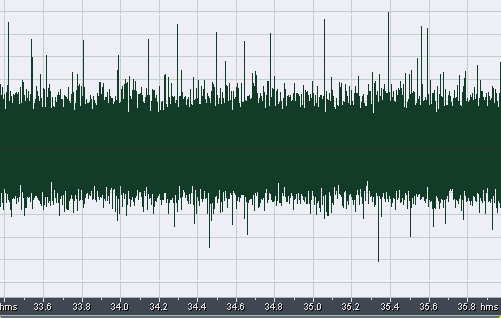
This is an oscilogram showing about two and a half seconds of
the impulse noise, riding over white noise, taken directly at the
discriminator, while applying a weak carrier that produces incomplete
quieting:
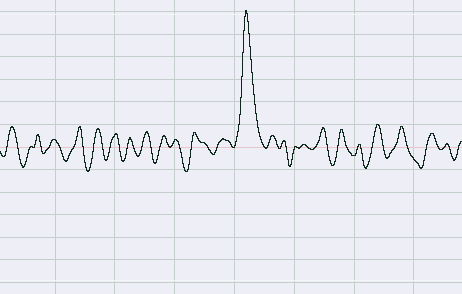
This is the detailed oscillogram of a single impulse, taken at the same
place, surrounded by normal white noise. The pulse width and shape
seems to be given by the discriminator's and IF bandwidth
characteristics:
And this is how it sounds, also directly at the discriminator: Poroteo.mp3
Any help is welcome!
Manfred